Estimated reading time: 8 minutes
What is a Corona Camera?
The Corona Camera is a very effective, sensitive instrument that can detect UV signals at a great distance in broad daylight, making it the perfect preventative maintenance tool for high-voltage substations and overhead transmission lines.
Insulation material failures can result in discharge failures that harm the implant, compromise the power supply, and potentially cause fires and explosions.
In order to control crucial electrical network components, the corona effect detection is utilized as a diagnostic tool. Corona and UV radiation can be recorded to assess a device’s condition using a very sensitive ultraviolet radiation camera. Preventive maintenance reduces costs significantly since failures in high voltage equipment involve a very high risk. Defects in the insulation or structural flaws may also cause partial discharges.
It is possible for electrical discharge to occur in most power lines, which may result in blackouts. This can also occur while high voltage electronic items are being produced on a production line.
Table of contents

Corona Discharge is the name that this discharge is more frequently known by. When a fluid (such the air surrounding an electrically-charged conductor) ionizes, an electrical discharge called a corona discharge takes place. To put it in simple terms, it is the sound that the air (around the power lines) creates while electricity passes through it. With the help of Corona camera, you can find electrical discharges before they harm a production line’s wires or power lines.
Drone Aerial Inspection using Corona Camera:
High-voltage electrical power lines’ electrical components frequently emit a bluish glow into the air around them. The electrical field must be strong enough to ionize the air surrounding the conducting materials in order for this glow, also known as a corona discharge, to occur.
For a number of reasons, corona discharge in high-voltage electrical power lines is undesirable. It frequently denotes energy waste and can make audible noises like buzzing, crackling, or humming. Unwanted electromagnetic energy produced by corona discharge may interfere with neighboring electrical components. Additionally, it could produce gases like ozone and nitric oxide, which, when mixed with water vapor, can corrode, deteriorate, and embrittle parts of the power line system like insulators, conductors, and cladding. As a result, electrical power providers are required to conduct routine inspections of their power lines to spot potential damage and regions with significant corona discharge.
There are a variety of techniques that can be used, some of which are non-destructive and non-intrusive, to find corona discharge and potential damage on power line equipment. These include expensive and dangerous nighttime visual inspections for the bluish discharge; audible inspections using antennas to hear hissing, buzzing, or crackling sounds; and daytime visual inspection using specialized sophisticated cameras that can locate, display, and record the discharges.
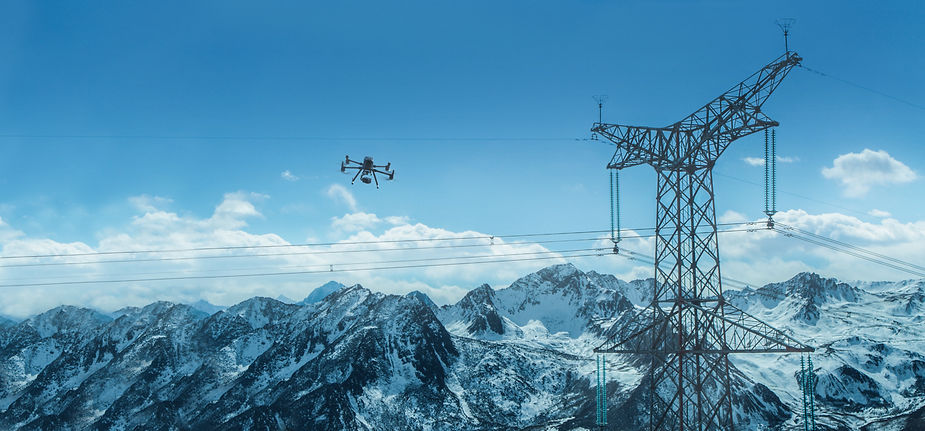
While corona discharge cannot be seen by the human eye during the day, these advanced cameras use two cameras whose outputs are combined and overlaid: a conventional HD camera and an ultraviolet (UV) camera. Here, an inspector can approach power lines within sight range, point the camera, and view a visual representation of the corona discharge. When corona discharge events are detected, recorded, and documented for analysis and archive retention, such systems do so quickly and effectively. Nevertheless, because such cameras should have a clear line of sight, inspectors must be in close proximity to the equipment being watched. Therefore, it is best to inspect that equipment from the air when inspecting facilities that have physical barriers, such as those that are difficult to access or are in hazardous areas.
The UV camera can precisely replicate the irradiance field radiation source on the order of 10-12-10-18W/cm2, properly detect the position and strength of the corona discharge, and identify the number of discharge photons with an accuracy of over 95%. The degree of discharge can be correctly assessed during the initial discharge stage, the suspected failure spot can be locked, and the foundation for precise maintenance may be laid.
How Does the Corona Drone Camera Operate?
The UV light produced when nitrogen comes into touch with a power leak is visible on a corona camera. Corona can be seen even in broad daylight since “normal” ultra violet light is blocked away. In order to precisely locate the corona during the measurements, a regular video image and the UV source are displayed concurrently.
The UV wavelength range is usually 40-400 nm. The UV light from the sun that reaches the Earth’s surface is mostly over 300 nm due to the ozone layer absorbing some of the longer UV waves. However, enhancing the camera’s efficiency would be possible by detecting UV waves with wavelengths below 300 nm. Thus, there will be no corona effects detection from the sun and the precise spot of the corona’s position and strength can be achieved by effectively processing data, images, and superimposing them with visible light images.
When compared to human inspections, drone inspections using Corona cameras are significantly more advantageous in terms of costs, danger, and time than human inspections.
How to Conduct a Drone Corona Inspection
How to Conduct a Drone Corona Inspection
- Plan the Flight Mission
Define the inspection area, key high-voltage components, and flight path to cover all critical points.
- Choose the Right Drone and Corona Camera
Equip the UAV with a solar-blind UV camera and HD visible-light camera for precise corona detection.
- Perform Pre-Flight Checks
Verify battery, gimbal stability, RTK calibration (if available), and safety clearance around high-voltage lines.
- Capture UV and Visual Data
Fly systematically to record corona discharge events and overlay UV images with HD video for clear documentation.
- Analyze the Data
Assess corona intensity, identify potential failures, and generate reports for maintenance planning.
- Schedule Regular Inspections
Repeat drone inspections periodically to prevent failures and maintain the electrical network’s reliability.
The UV drone Gimbal camera has the following advantages:
1. Remote data collection:
Without the aid of ground-based equipment, drones are able to fly at varied heights and cover wide distances, allowing them to collect UV data from multiple locations. The ability to collect data remotely makes it simpler to evaluate UV radiation levels in large or difficult-to-reach places.
2. High spatial resolution:
Drones have the ability to fly at precise heights and angles, delivering high-resolution UV data that can be used to detect regional differences in UV radiation levels.
3. Environmental applications:
Multiple habitats, including forests and marine areas, are impacted by UV radiation. Drones can be used to measure the effects of UV radiation on these ecosystems and support conservation efforts.
4. Real-time monitoring:
The implementation of real-time monitoring through drone technology has revolutionized the acquisition of UV radiation data. Drones’ agility and aerial perspective allow for swift capture and transmission of up-to-the-minute information, enabling rapid analysis and response to UV fluctuations. This capability proves particularly vital in contexts where UV exposure presents health risks to humans and impacts the environment.
5. UV mapping and modeling:
Drones have the ability to fly over an area and collect data from various points, creating UV maps. These maps provide a clear picture of how UV radiation is distributed and patterns of exposure across the surveyed region, allowing for a better understanding of where and how UV rays are impacting the area.
6. High Level of Precision:
Solar-blind ultraviolet and visible light picture fusion technology is used in the camera. It is used in conjunction with drones to identify early insulation damage to electrical components and overhead transmission lines, to precisely assess the degree of discharge, to lock suspected problem spots, and to combine with the laser ranging module to make the photon count value measurably high. Provide a precise maintenance schedule.
7. High Degree of Consistency:
In order to enable the research of decision-making difficulties in UV-related applications and to detect early insulation deterioration of overhead transmission lines and electrical components, metrological consistency is the foundation for the quantitative analysis of UV module or instrument field application.
Summing Up
Drone aerial inspections using Corona Cameras provide precise, efficient, and safe detection of corona discharges on high-voltage substations and transmission lines. Equipped with solar-blind UV cameras, drones detect early insulation damage, map discharge intensity, and support preventive maintenance. This reduces costs, enhances reliability, and ensures worker safety in hazardous areas.
Frequently Asked Questions About Drone Corona Inspections
Drones improve safety, reduce costs, and enable rapid inspection of hard-to-reach high-voltage areas.
It uses solar-blind UV sensors fused with HD video to visualize corona discharge during daytime.
Yes, the UV camera identifies early-stage discharge, helping prevent power outages and costly equipment damage.
Drones minimize human exposure to hazards and can map UV radiation in sensitive ecosystems.
Want professional drone aerial inspection solutions with advanced Corona camera technology?
Contact NineTenths today to discover how drone‑based inspections using Corona cameras can deliver high‑resolution imaging, faster defect detection, and enhanced reporting for infrastructure, utilities, and industrial assets: