
🌍Telecom Tower Inspection Using Drones Without Service Downtime in Saudi Arabia
Project Overview
Telecommunication towers are critical assets supporting uninterrupted mobile connectivity across Saudi Arabia. Operators must regularly inspect towers for structural integrity, antenna alignment, corrosion, cable condition, and equipment stability — but traditional inspection requires technicians to climb or use rope access, with extensive safety planning, longer durations, and higher costs. NineTenths was engaged to perform a comprehensive telecom tower drone inspection across multiple sites while keeping every service fully operational throughout.
Key Takeaways
- Telecom tower drone inspection allows for comprehensive assessments without service downtime, enhancing operational efficiency in Saudi Arabia.
- Challenges included needing detailed visual documentation while avoiding service disruptions during inspections of towers exceeding 80 meters.
- NineTenths used UAV technology to capture high-resolution imagery, creating a 3D model for engineers to reference and track maintenance.
- The inspection revealed early-stage corrosion and other maintenance needs, significantly improving the documentation process.
- Drone inspections reduced overall inspection time by 60% compared to traditional methods, ensuring better safety and faster assessments.
The Challenge
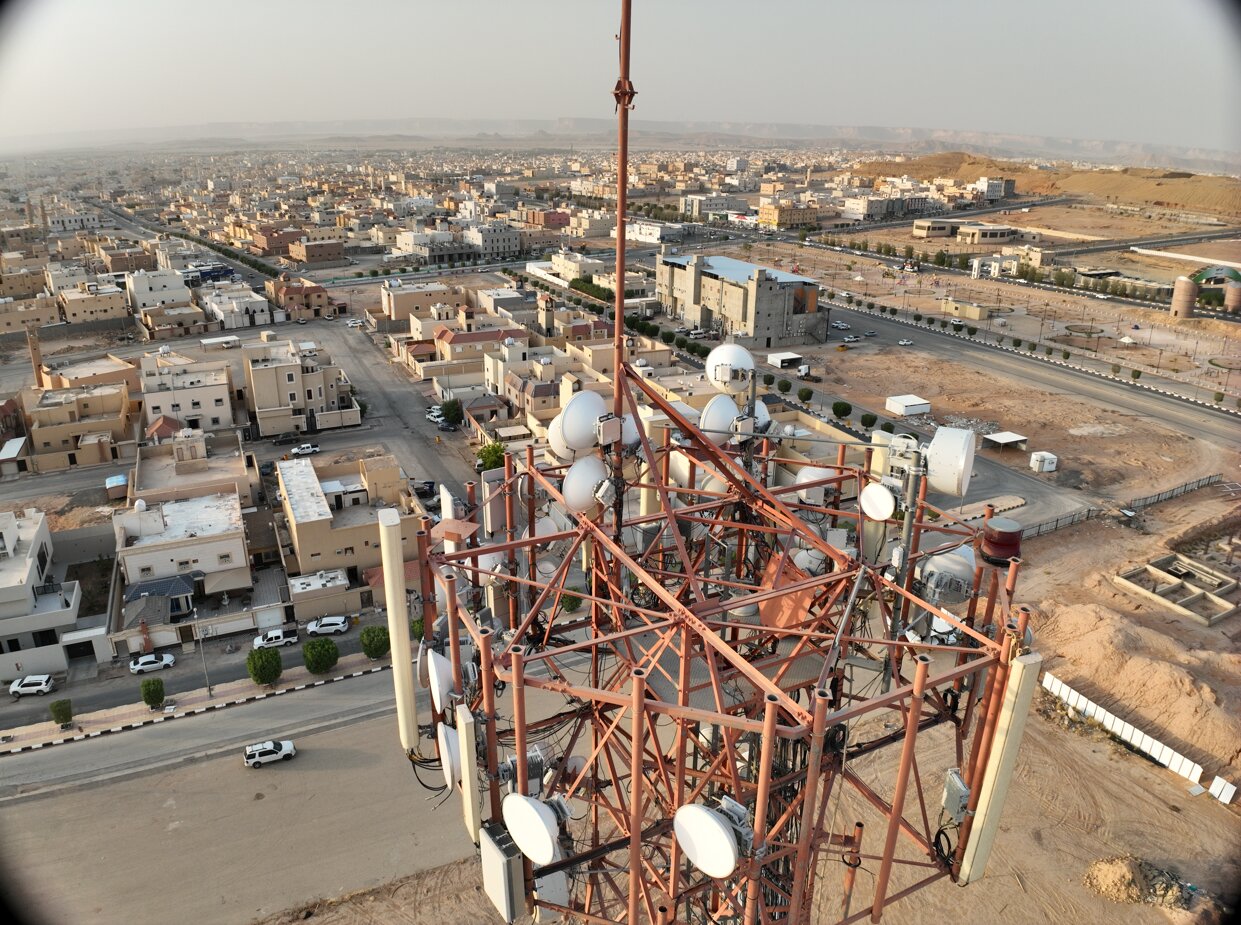
The client faced several operational challenges: inspections had to be completed without disrupting live telecom services, since any unnecessary shutdown could affect network availability and customer experience. The towers ranged from 40 to over 80 meters in height, and manual access would have required certified climbing teams, specialized safety equipment, and favorable weather conditions. The client also wanted detailed visual documentation — not just a basic report — that engineers could review later, share across departments, and compare against future inspections to track asset deterioration.
Our Approach
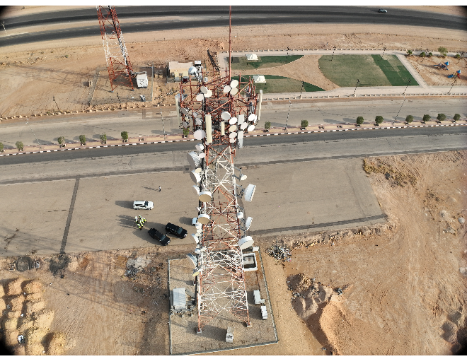
Before mobilization, the UAV team carried out a site assessment to identify nearby obstacles, antenna locations, electromagnetic interference risks, and safe take-off and landing zones. A flight plan was developed for each tower to ensure complete coverage while maintaining a safe stand-off distance from sensitive telecom equipment. Using an enterprise-grade UAV with a high-resolution zoom camera, pilots captured detailed images of every section of the tower from multiple angles — reaching components that are often difficult or unsafe to access manually. Communication equipment remained live throughout, with no interruption to network services required.
Inspection Scope
The inspection covered a detailed assessment of:
- Tower legs and structural members
- Bolted and welded connections
- Antenna mounting brackets
- Microwave dishes
- RF antennas
- Feeders and communication cables
- Cable clamps and support systems
- Lightning protection systems
- Corrosion and protective coatings
- Signs of deformation or mechanical damage
- Missing or loose hardware
- General tower condition
Close-up imagery let engineers zoom into individual components without physically accessing the structure.
Technology Used
NineTenths deployed enterprise UAV technology featuring high-resolution optical imaging, hybrid zoom capability for close-up inspection, GPS-assisted stable flight, obstacle sensing for safe operation near tower structures, and intelligent flight planning for consistent inspection routes. Collected data was reviewed after each flight to confirm complete coverage before leaving the site.
Beyond individual photos, the captured imagery was also processed into a 3D photogrammetry model of the tower and its surrounding site. This model reconstructs the full structure and surrounding area in three dimensions, with individual inspection points that can be selected directly within the model — giving engineers a persistent, navigable digital reference of the site rather than a static photo set alone.

Key Findings
The drone inspection identified several maintenance observations that would have been difficult to detect during a routine ground-based visual assessment, including:
- Early-stage corrosion on selected steel members
- Loose cable support brackets
- Minor deterioration of protective coatings
- Missing fasteners on secondary mounting components
- Cable management issues requiring preventive maintenance
Each observation was documented with high-resolution imagery, letting maintenance teams prioritize corrective actions by severity.
Results
- No Service Interruption — telecom infrastructure remained fully operational throughout, eliminating the need for planned outages
- Improved Safety — no technicians were required to climb the tower, substantially reducing working-at-height risks
- Faster Inspection — drone deployment reduced overall inspection duration by approximately 60%, enabling multiple telecom sites to be inspected within a single day
- Better Documentation — a comprehensive digital inspection record with high-resolution photographs, plus a navigable 3D photogrammetry model of the site, now serves as a baseline for future inspections and asset lifecycle management
Why This Matters
As telecom infrastructure continues expanding across Saudi Arabia, operators are under increasing pressure to maintain high service availability while controlling operational costs. Drone inspections address both objectives — allowing engineers to inspect critical assets quickly, safely, and accurately, while creating permanent digital records that improve maintenance planning, simplify compliance reporting, and support predictive asset management. Rather than reacting to equipment failures, operators can identify developing issues early and schedule maintenance before it affects network performance. This same shift toward drone-first inspection is playing out across other high-risk environments too — see how NineTenths eliminates human entry in confined space industrial inspections for another example.
Conclusion
This project demonstrated how drone technology can modernize telecom infrastructure inspections without compromising service availability. By combining advanced UAV technology with experienced pilots and structured inspection workflows, NineTenths delivered a safer, faster, and more comprehensive inspection process — while keeping the client’s communication network fully operational. As Saudi Arabia continues investing in smart infrastructure and digital connectivity, telecom tower drone inspection is becoming an essential tool for operators seeking to improve safety, reduce maintenance costs, and maximize network reliability. This project is one example of our cell tower inspection services, part of NineTenths’ broader specialized aerial inspection offering covering power lines, pipelines, bridges, and other critical infrastructure across Saudi Arabia.
How NineTenths Conducts a Telecom Tower Drone Inspection
How NineTenths Conducts a Telecom Tower Drone Inspection
- Step 1: Site Assessment
Identify nearby obstacles, antenna locations, electromagnetic interference risks, and safe take-off/landing zones.
- Step 2: Flight Planning
Develop a tower-specific flight plan ensuring complete coverage while maintaining a safe stand-off distance from sensitive equipment.
- Step 3: UAV Deployment
Fly an enterprise-grade UAV with a high-resolution zoom camera around every section of the tower from multiple angles, with communication equipment remaining fully live.
- Step 4: Component-Level Imaging
Capture close-up imagery of structural members, connections, antennas, dishes, cables, and lightning protection systems.
- Step 5: On-Site Data Review
Review collected data after each flight to confirm complete coverage before leaving the site.
- Step 6: Reporting & Documentation
Compile a digital inspection record with high-resolution photographs, prioritized by severity, for maintenance planning.
Frequently Asked Questions: Telecom Tower Drone Inspection
Yes. In this project, communication equipment remained fully live throughout the drone inspection, and no interruption to network services was required.
The towers inspected in this project ranged from 40 to over 80 meters, with the UAV capturing detailed imagery across the full height of each structure without requiring manual climbing.
It typically covers tower legs and structural members, bolted and welded connections, antenna mounting brackets, microwave dishes, RF antennas, feeders and cables, cable clamps, lightning protection systems, corrosion and coatings, and any deformation, damage, or missing hardware.
In this project, drone deployment reduced overall inspection duration by approximately 60%, allowing multiple telecom sites to be inspected within a single day.
This inspection identified early-stage corrosion on steel members, loose cable support brackets, minor coating deterioration, missing fasteners on secondary components, and cable management issues — all of which are difficult to detect from ground level.
As telecom infrastructure expands, operators need to maintain high service availability while controlling costs. Drone inspections deliver fast, safe, accurate assessments and create permanent digital records that support predictive maintenance and compliance reporting.
📩 Ready to Inspect Your Telecom Towers Without Downtime?
With NineTenths, telecom tower drone inspection keeps your network fully live while delivering faster, safer, and more detailed inspections than manual climbing methods.
📩 Contact Us
📞 Or speak with a specialist: 920015910