
🌍Environmental Monitoring Innovation: Autonomous Drone Monitoring in Saudi Arabia
🏢 Case Study Overview
This case study highlights autonomous drone monitoring in Saudi Arabia, where NineTenths helped the Environmental Security Task Unit faced a critical challenge: how to continuously monitor vast and fragile ecosystems like Salbukh without relying on fuel-heavy patrols or costly helicopter missions.
Traditional surveillance methods often left blind spots, suffered from delays, and consumed significant resources. Recognizing these limitations, the Task Unit embraced autonomous drone technology powered by NineTenths, integrating DJI Dock 2, the Matrice series UAVs, and FlightHub 2 software.
This transition represented a paradigm shift in environmental protection. With drones providing 24/7 automated monitoring, the Unit reduced operational costs, expanded coverage, and ensured faster response times — all while safeguarding sensitive desert ecosystems in alignment with Saudi Vision 2030 sustainability and smart governance goals.
🛡️ About the Client: Environmental Security Task Unit
The Environmental Security Task Unit is a specialized government-linked agency tasked with protecting Riyadh’s most ecologically sensitive desert landscapes.
Key Responsibilities:
Traditional inspection methods rely on ground teams walking through vast solar arrays with handheld devices. For a 600 MW project, this means inspecting millions of square meters manually — a nearly impossible task.
Key challenges included:
- Detect and prevent illegal dumping.
- Monitor and reduce wildfire risks.
- Protect fragile habitats from encroachment and disruption.
- Safeguard biodiversity through rapid hazard detection.
These responsibilities are particularly vital in arid regions where ecosystems are delicate and recovery from environmental damage can take decades. Operating in extreme conditions of heat, dust, and high winds, the Unit required technology that is rugged, autonomous, and dependable, capable of delivering real-time intelligence with minimal human intervention.
🚨 Traditional Pain Points Before Drone Adoption
Before UAV technology, the Task Unit primarily relied on:
- Ground patrols → long hours, high manpower needs, and limited coverage. In many cases, patrol teams could only cover a fraction of the desert, leaving large blind spots.
- Helicopter missions → while effective for aerial coverage, these were prohibitively expensive, consuming large amounts of fuel and requiring specialized crews. They were unsustainable for frequent monitoring.
- Manual data collection → delayed reporting, inconsistent results, and restricted operations limited to daylight. Reports often reached decision-makers too late to act proactively.
The result was a reactive monitoring model, where environmental violations — from illegal waste dumping to fires triggered by dry vegetation — were often identified only after significant damage. Such delays threatened not only local ecosystems but also the Kingdom’s long-term sustainability objectives under Vision 2030.

🚁 Drone-Powered Solution & Value Analysis
The integration of DJI Dock 2, Matrice UAVs, and FlightHub 2 software created a new operational standard.
Key Impact Metrics
- 29% reduction in operational costs by minimizing reliance on helicopters and fuel.
- 70% increase in surveillance coverage compared to manual patrols.
- 24/7 autonomous monitoring, unaffected by daylight restrictions.
- 100% real-time mission data access, strengthening command decisions.
This solution transformed monitoring from reactive to proactive, ensuring rapid identification of threats, optimized resource allocation, and a consistent operational rhythm.
✅ Hardware Configuration
The deployment was built on DJI’s robust UAV ecosystem:
| DJI Dock 2 | fully autonomous charging and deployment station, built for desert conditions. Capable of remote mission scheduling and fast recharging to maximize uptime. |
| Matrice 300 RTK | flagship UAV with 55-minute endurance, dual thermal and zoom payloads, IP45 weather resistance, and six-direction obstacle sensing. |
| Matrice 3TD & M30T | compact UAVs with thermal imaging, night operations, and enhanced stabilization — ideal for confined zones and rapid-response missions. |
🧩 Software Capabilities: DJI FlightHub 2
FlightHub 2 provided the digital backbone for operations:
- PINPoint Environmental AI → automated anomaly detection, flagging illegal dumping, fire risks, and vegetation changes.
- Smart Mission Planning → pre-programmed flight paths covering 20 km² daily, with adjustable altitude, speed, and sensor settings.
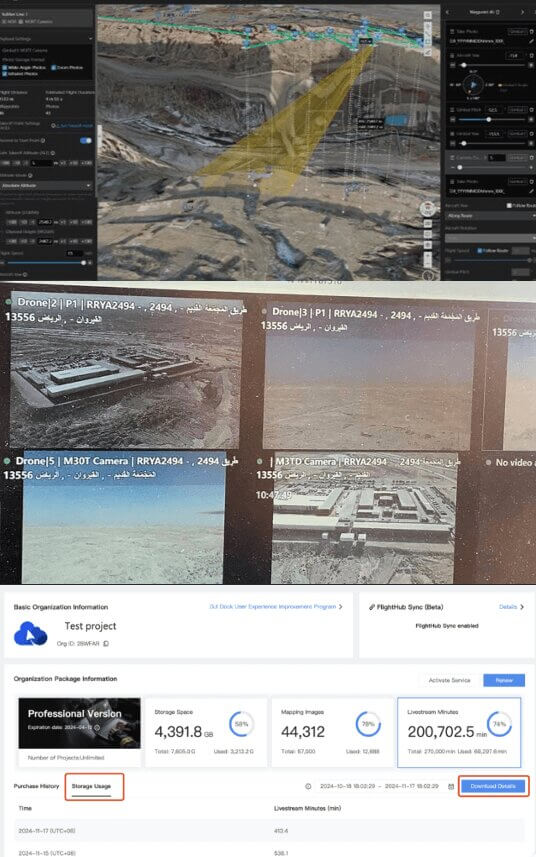
- Centralized Control → real-time coordination of multiple UAVs with live feeds, mission annotations, and telemetry tracking.
- Data Management → automatic archiving with metadata tagging, ensuring traceability and simplifying audits.
This combination ensured seamless collaboration, giving every stakeholder access to live mission data without delay.
🔄 Operational Workflow Transformation
The Environmental Security Task Unit restructured its operations into a fully autonomous cycle:
- Mission Planning → commanders use historical data and risk assessments to schedule flights.
- Autonomous Deployment → DJI Dock 2 initiates checks, launches drones, and manages landings autonomously.
- Data Acquisition → drones perform hourly missions, capturing high-resolution RGB and thermal data.
- Real-Time Monitoring → live video feeds stream to command centers for immediate evaluation.
- Rapid Response → AI-generated alerts automatically dispatch ground units, reducing response times from hours to minutes.
This workflow eliminated blind spots, created a predictive monitoring culture, and significantly reduced human workload.
📣 Client Feedback
The Task Unit reported:
- Faster coordination between field operators and command centers.
- Improved reliability, with fewer interruptions caused by weather or resource limits.
- Greater decision-making accuracy, as leaders now had direct access to UAV data.
One commander noted:
💬 Client Feedback
“The ability to monitor all drones simultaneously in real time has completely transformed our operations. We no longer wait for delayed reports — decisions are now instant, accurate, and effective.”
This testimonial highlights not only operational efficiency but also cultural change, as teams now rely on data-driven insights instead of reactive field reports.
🌐 Scalability & Regional Potential
The success in Salbukh is more than a local achievement — it presents a scalable model for Saudi Arabia and beyond.
Immediate Expansion Plans
- Rollout of additional DJI Dock 2 units across the Kingdom.
- Integration of AI-powered predictive analytics for wildfire detection.
- Cloud-based coordination, enabling multi-site monitoring nationwide.
Regional & International Applications
- Middle East & North Africa (MENA) → desert ecosystems in the UAE, Oman, and Morocco face similar monitoring challenges.
- Oil & gas security → pipeline corridors across Saudi Arabia and the Gulf require constant surveillance.
- Wildlife conservation → endangered species in North Africa and the Arabian Peninsula benefit from UAV-based tracking.
- Disaster response → drones can support emergency relief in floods, sandstorms, or wildfires.
By adopting such a framework, governments and agencies across the region can reduce costs, improve sustainability, and align with global environmental goals.
🌱 Broader Environmental Impact
Beyond operational efficiency, the UAV deployment contributed to environmental sustainability:
- Lower carbon footprint → replacing fuel-heavy patrols and helicopters with electric drones.
- Biodiversity protection → quicker identification of illegal activities prevents long-term habitat loss.
- Data-driven conservation → collected imagery provides insights for environmental planning, supporting Saudi Arabia’s Vision 2030 ecological goals.
These outcomes illustrate how technology and sustainability intersect, creating smarter ways to protect natural resources.
🔚 Conclusion
The Environmental Security Task Unit’s adoption of NineTenths’ autonomous drone monitoring solution has set a new benchmark for environmental surveillance in Saudi Arabia.
By combining:
- Autonomous UAVs (DJI Dock 2, Matrice series),
- Advanced software (FlightHub 2, PINPoint AI), and
- Intelligent operational workflows,
the Unit achieved 24/7 visibility, reduced costs, and faster responses, ensuring fragile desert ecosystems remain protected.
This case study proves that autonomous UAV surveillance is more than a tool — it is the future of environmental monitoring. From Riyadh’s deserts to conservation zones worldwide, the model provides a scalable, sustainable, and data-driven approach for protecting our planet.
📩 Ready to Elevate Your Monitoring Operations?
Whether you’re managing a protected ecosystem, industrial zone, or critical infrastructure, NineTenths delivers end-to-end drone solutions tailored to your needs.
To learn how our drone-powered solutions can optimize your solar asset performance — with speed, accuracy, and zero disruption.
📩 Contact Us
📞 Or speak with a specialist: 920015910